
 Humphreys Family
Movement Disorder Clinic
Research / Team research
Team research
Our clinic team and research partners study movement in everyday life, from short exercise sessions at home to changes in hand function and blood pressure.
Handcycling and hand dexterity in Parkinson’s
In the ICEBERG pilot, clinic physiotherapist Sierra Castonguay and colleagues asked whether five minutes of seated handcycling could change how easily people with Parkinson’s use their hands. Participants tried both a steady pace and short bursts of faster cycling. The team tested dexterity with a pegboard before and after each session.
Responses varied from person to person. The pilot raised a question for a larger study: do sprint intervals help hand dexterity more than a steady pace, and if so, for how long?
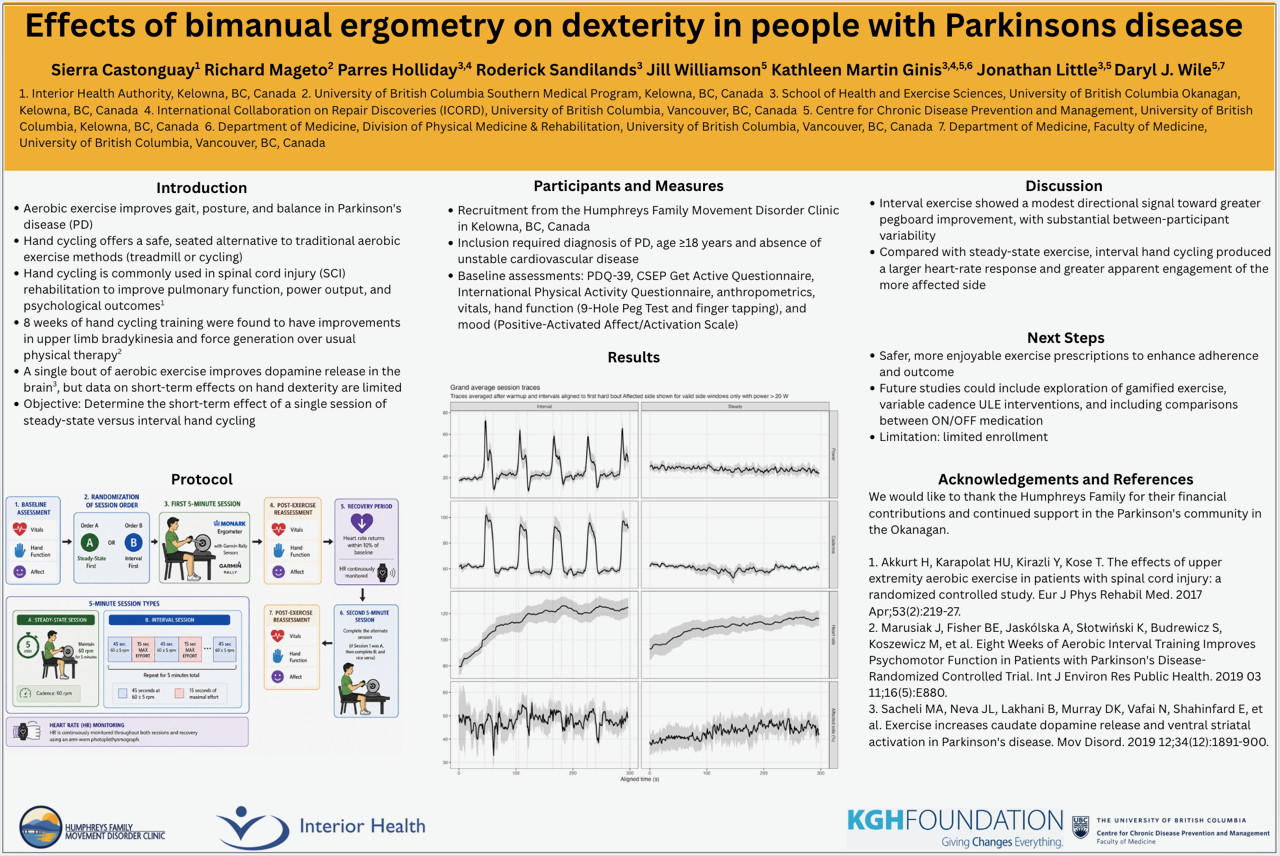
Read the published World Parkinson Congress abstract (P14.33)
Exercise studies
TAPAS-PD
Can short sessions of aerobic or strength exercise at home make everyday activities easier for people with Parkinson’s? This three-site study brings together teams in Kelowna, Kamloops and Prince George.
SNACK-PD
Our 12-week Kelowna pilot compared brief exercise snacks with lower-intensity movement breaks.
Selected publications
Blood pressure and mobility in Parkinson’s
Parres Holliday and colleagues studied blood pressure after standing in 57 people attending the clinic. About half had a measurable drop, and few reported symptoms during testing. A delayed drop was associated with greater difficulty with mobility. Read the 2026 Canadian Journal of Neurological Sciences paper.
Medication and upper limb function
Parisa Alaei, Daryl Wile and Jennifer Jakobi examined how Parkinson’s medication affects arm strength and hand dexterity. A follow-up collaboration studied how motor neurons respond on and off medication. Read the 2025 upper limb study or the 2026 motor neuron study.

Humphreys Family
Movement Disorder Clinic
Kelowna General Hospital
Visit us
Walter Anderson Building
2251 Pandosy Street, Kelowna
South end of the second-floor hallway
Contact
250-862-4181
Fax: 250-862-4463
Monday–Friday, 8 am–4 pm
Contact & referrals